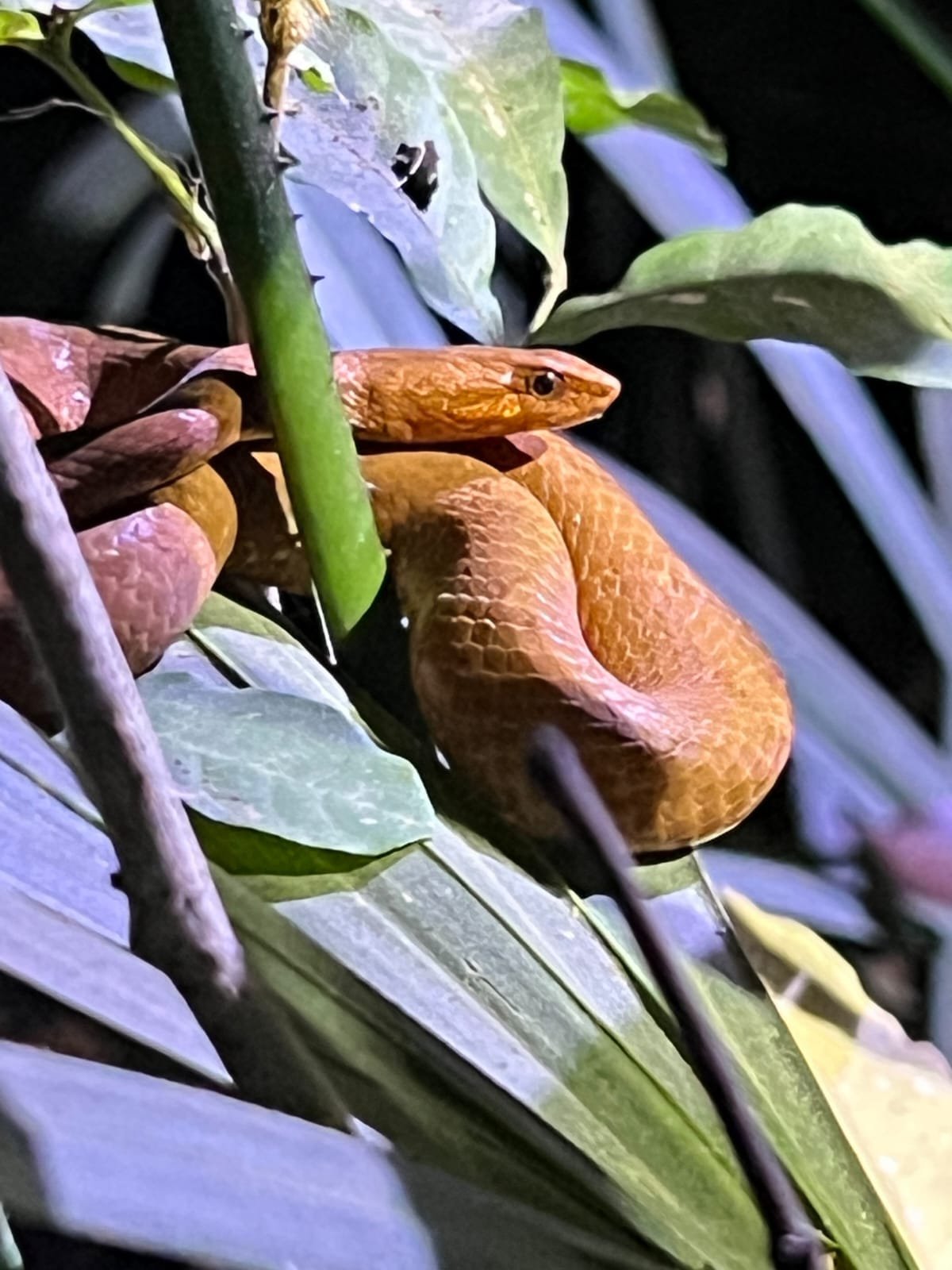
SNAKEMOCK VIPER- WILDLIFE DISCOVERY: Psammodynastes pulverulentus
Small in Size. Remarkable in Adaptation.
1. Introduction
The Common Mock Viper (Psammodynastes pulverulentus) is a small snake native to South and Southeast Asia, including Indonesia. Its common name comes from its resemblance to true vipers, particularly its relatively broad head, defensive posture, and viper-like appearance.
Despite its name, the Common Mock Viper is not a true viper. It belongs to a different snake lineage and has distinct anatomical and behavioral characteristics.
This species is an interesting example of how animals can develop physical features that resemble those of other species, helping them respond to potential threats in their natural environment.
2. Physical Characteristics
The Common Mock Viper typically has a brown, grayish-brown, or reddish-brown body, often accompanied by darker markings and irregular patterns. Its coloration varies between individuals and helps it blend into leaf litter, tree branches, and forest vegetation.
Its head is relatively broad and distinct from the neck, creating a triangular appearance similar to that of true vipers. Its eyes and facial structure further contribute to this resemblance.
Adults generally remain relatively small compared with many other snake species, commonly reaching approximately 50–65 cm in total length, although larger individuals have been reported.
3. Habitat and Distribution
The Common Mock Viper has a broad distribution across South and Southeast Asia. Its recorded range includes parts of India, Bangladesh, Nepal, Myanmar, Thailand, Vietnam, southern China, Malaysia, the Philippines, and Indonesia.
Within Indonesia, records include several islands and regions across the archipelago.
It inhabits a variety of environments, including forests, forest edges, plantations, and areas with dense vegetation. Depending on local conditions, it may be encountered on the ground or among low vegetation.
Its camouflage allows it to remain relatively inconspicuous in its surroundings, making careful observation important when exploring natural habitats.
4. Behavior and Defense
The Mock Viper is known for its defensive behavior, which can resemble that of a true viper.
When threatened, it may remain motionless, adopt a defensive posture, coil its body, or strike in an attempt to discourage a potential predator.
One particularly interesting feature documented in mock vipers is their ability to alter the apparent shape of their pupils under certain conditions. This may contribute to their resemblance to true vipers.
These defensive adaptations demonstrate how appearance and behavior can influence an animal's interactions with potential threats.
5. Diet and Ecological Role
The Common Mock Viper is a predator that feeds primarily on small vertebrates, including frogs and lizards. Its precise diet may vary depending on the habitat and prey available.
By feeding on small animals, it contributes to the ecological relationships that maintain balance within its environment.
Like other snakes, it forms part of the food web and may itself become prey for larger predators.
6. Venom and Safety
The Common Mock Viper is a rear-fanged snake with venom-delivery adaptations. It is not considered comparable in medical danger to highly venomous true vipers, but it should not be handled or assumed to be harmless.
A bite can cause pain or local injury, and individual reactions may vary.
Safety guidelines:
- Observe the snake from a safe distance.
- Never attempt to handle, capture, or provoke it.
- Do not rely on head shape or coloration alone to identify a snake.
- If bitten, seek medical advice promptly, particularly if symptoms develop or the species is uncertain.
Responsible observation protects both people and wildlife.
7. Conservation and Wildlife Awareness
Snakes play important roles in natural ecosystems, yet they are often misunderstood because of their appearance or reputation.
Learning about the Mock Viper helps distinguish similar-looking species and encourages a more informed approach to wildlife encounters.
Protecting natural habitats, avoiding unnecessary killing, and observing wildlife without disturbance are practical ways to support biodiversity.
8. Conclusion
The Common Mock Viper (Psammodynastes pulverulentus) demonstrates that nature's adaptations are not always what they first appear to be. Its viper-like appearance, defensive behavior, and role as a small predator make it a fascinating subject for wildlife discovery.
By studying this species, we gain a greater appreciation of snake diversity and the importance of understanding wildlife before judging it by appearance alone.
Observe with respect. Learn before you judge. Protect wildlife.
Scientific References
1. The Reptile Database
Species taxonomy, accepted scientific name, and common name.
https://reptile-database.reptarium.cz/Psammodynastes/pulverulentus
2. Thailand National Parks — Common Mock Viper
Species profile covering identification, distribution, and natural history.
https://www.thainationalparks.com/species/psammodynastes-pulverulentus
3. Ecology Asia — Common Mock Viper
Information on physical characteristics, diet, habitat, and behavior.
https://www.ecologyasia.com/verts/snakes/common-mock-viper.htm
4. Silva, F. et al. (2016). “More than meets the eye: change in pupil shape by a mock viper.” Frontiers in Ecology and the Environment.
Research discussing the unusual defensive resemblance between mock vipers and true vipers.
https://doi.org/10.1002/fee.1420
5. Universitas Pakuan — Illustrated Guide to Indonesian Snakes
Illustrated reference discussing the genus Psammodynastes and the identification of mock vipers in Indonesia.
https://sipus-old.unpak.ac.id/file/PANDUAN%20BERGAMBAR%20ULAR%20JAWA_compressed.pdf
WILDLIFE DISCOVERY — Exploring the beauty, science, and diversity of the natural world.