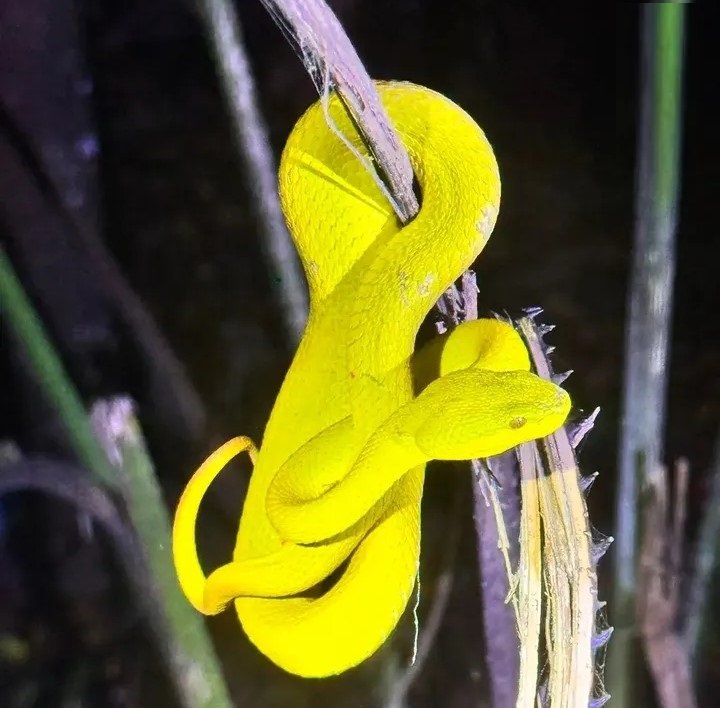
GREEN & YELLOW SNAKE- WILDLIFE DISCOVERY
The Beauty of Nature. The Mystery of the Wild.
1. Introduction
The Trimeresurus insularis, commonly known as the White-lipped Island Pit Viper, is a venomous snake native to the Lesser Sunda Islands of Indonesia. This species belongs to the family Viperidae and is recognized for its striking coloration, arboreal lifestyle, and ecological role as a predator.
Found across several Indonesian islands, including Bali, Lombok, Sumbawa, Flores, Sumba, and Timor, this pit viper is an important part of the regions unique biodiversity.
Although the species is commonly associated with bright green coloration, individuals may exhibit different color variations, including blue. Its appearance makes it a fascinating subject for wildlife photography and herpetological observation.
2. Physical Characteristics
The White-lipped Island Pit Viper has a relatively slender body, a distinctly triangular head, and vertically elliptical pupils. Like other pit vipers, it possesses heat-sensitive loreal pits that help detect warm-blooded prey.
Its coloration is highly distinctive. Green individuals blend remarkably well with tropical vegetation, while blue individuals are also known to occur. Yellowish or pale markings may be visible in certain individuals, although green and blue are the better-documented color forms.
The snakes scales may appear glossy under natural light, enhancing its vivid appearance in photographs. However, the exact coloration can vary with lighting, individual variation, and photographic conditions.
3. Habitat and Distribution
Trimeresurus insularis inhabits tropical environments throughout the Lesser Sunda Islands. It may be encountered in forests, shrubland, plantations, gardens, and other areas with suitable vegetation.
As a primarily arboreal and nocturnal snake, it often rests among branches and foliage during the day and becomes more active after dark.
Its ability to remain motionless among leaves provides effective camouflage, allowing it to avoid detection by potential threats and ambush passing prey.
4. Behavior and Diet
This species is an ambush predator. Rather than actively chasing prey over long distances, it typically waits for an opportunity to strike.
Its diet includes small vertebrates such as frogs, lizards, birds, and small mammals. Its flexible feeding behavior allows it to exploit prey available in its surrounding habitat.
Although it may remain motionless for extended periods, it can react defensively when disturbed. Its quiet behavior should never be interpreted as an indication that it is harmless.
5. Venom and Safety
The White-lipped Island Pit Viper is a venomous snake equipped with specialized front fangs that deliver venom during a bite.
Scientific research has documented the biochemical composition of its venom and variation in venom activity among populations from different islands of the Lesser Sunda Archipelago.
A bite may cause pain, swelling, bleeding, tissue injury, or other complications. The severity can vary, and any suspected bite requires urgent medical assessment.
Safety guidelines:
- Observe the snake from a safe distance.
- Never attempt to handle, capture, or provoke it.
- Do not attempt to kill or relocate it yourself.
- If bitten, seek emergency medical treatment immediately.
- Do not cut the wound, suck out venom, or apply a tight tourniquet.
Respecting this animals space is essential for both human safety and wildlife protection.
6. Ecological Importance
As a predator, Trimeresurus insularis contributes to the balance of local ecosystems by feeding on small vertebrates.
Its presence also reflects the ecological diversity of Indonesias islands, where species have evolved in geographically distinct environments.
Understanding its natural history helps promote responsible wildlife observation and encourages appreciation for species that are often misunderstood because of their venomous nature.
7. Conservation and Responsible Observation
Wildlife conservation begins with understanding and respecting the animals that share our environment.
When encountering a pit viper in the wild, avoid disturbing its habitat or attempting to collect it. Photographing wildlife from a safe distance is a more responsible way to document its beauty and behavior.
The species' global conservation status should be checked against the latest assessment from the International Union for Conservation of Nature (IUCN) before publication.
8. Conclusion
The Trimeresurus insularis is a remarkable example of Indonesias rich reptile diversity. Its vivid coloration, specialized hunting adaptations, and island distribution make it an interesting subject for scientific study and wildlife photography.
Beyond its striking appearance, this snake reminds us that every species has a role in nature and deserves to be treated with respect.
Observe with respect. Photograph responsibly. Protect wildlife.
Scientific References
- Jones, B. K., et al. (2019). “Venom Composition in a Phenotypically Variable Pit Viper (Trimeresurus insularis) across the Lesser Sunda Archipelago.” Journal of Proteome Research, 18(5), 2206–2220.
DOI: https://doi.org/10.1021/acs.jproteome.9b00077 - Anita, S., et al. (2022). “Venom composition of Trimeresurus albolabris, T. insularis, T. puniceus and T. purpureomaculatus from Indonesia.” Journal of Venomous Animals and Toxins Including Tropical Diseases, 28, e20210103.
DOI: https://doi.org/10.1590/1678-9199-JVATITD-2021-0103 - Integrated Taxonomic Information System (ITIS). Trimeresurus insularis — Taxonomy and nomenclature.
https://www.itis.gov/servlet/SingleRpt/SingleRpt?search_topic=TSN&search_value=1058477 - National Center for Biotechnology Information (NCBI). Taxonomy Browser: Trimeresurus insularis.
https://www.ncbi.nlm.nih.gov/Taxonomy/Browser/wwwtax.cgi?id=174297 - Bali Wildlife. “Ular Hijau Ekor Merah (Trimeresurus insularis).” Species profile covering habitat, distribution, and behavior.
https://baliwildlife.com/id/ensiklopedia/hewan/reptil/ular/ular-hijau-ekor-merah-trimeresurus-insularis/