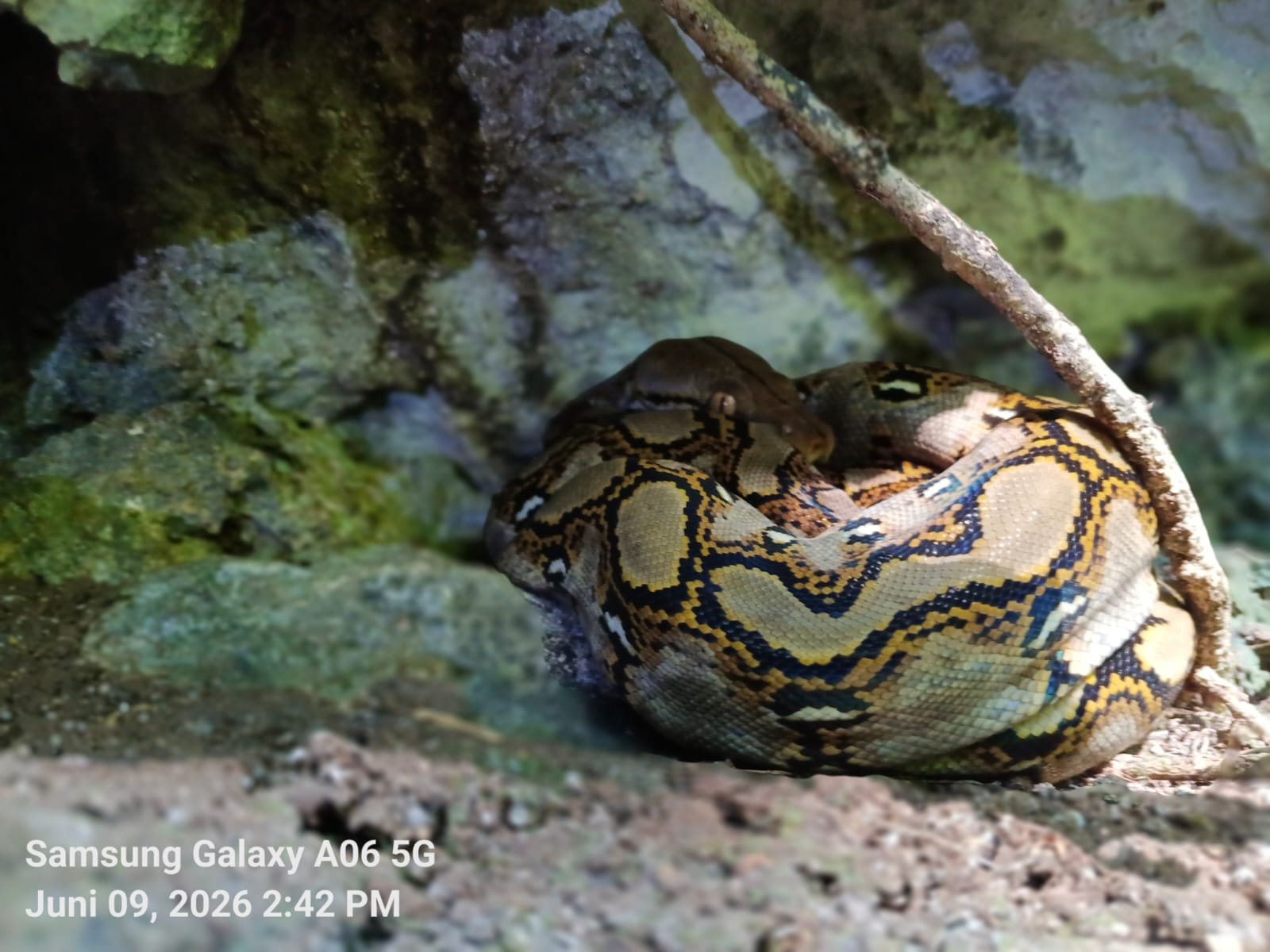
TIMOR PYTHON: Malayopython timoriensis
The Hidden Beauty of Indonesia's Lesser Sunda Islands
1. Introduction
The Timor Python (Malayopython timoriensis), also known as the Lesser Sundas Python, is a non-venomous snake belonging to the family Pythonidae. This species is native to the Lesser Sunda Islands of Indonesia and represents an important part of the country's unique reptile diversity.
Despite its common name, the Timor Python is not confirmed to inhabit Timor Island itself. Reliable records indicate its presence on several neighboring islands, including Flores, Lembata, Solor, Adonara, and Pantar.
This python is distinguished by its relatively slender body, intricate dark markings, and coloration that transitions from lighter olive or yellowish-brown tones toward darker brown along its body.
2. Physical Characteristics
The Timor Python has a more slender appearance than many other large python species. Adults typically reach approximately 1.5–2.4 meters in length, although larger individuals have been reported.
Its coloration is particularly distinctive. The head and front portion of the body may display pale yellowish or olive-brown tones, accompanied by irregular dark brown markings. Toward the middle and rear of the body, these markings may become less distinct as the coloration transitions into darker brown.
Under natural light, its scales may display an iridescent sheen, creating subtle reflective colors across the skin.
These features make the species an interesting subject for wildlife photography, particularly when its natural coloration is observed in different lighting conditions.
3. Habitat and Distribution
Malayopython timoriensis is endemic to the Lesser Sunda Islands of Indonesia.
Its known distribution includes several islands in the Nusa Tenggara region, particularly Flores and nearby islands. The species has been associated with open forests, grasslands, shrublands, and other relatively dry landscapes.
Although it can spend time on the ground, the Timor Python is also partly arboreal, meaning it can climb and use vegetation as part of its habitat.
Its distribution is geographically restricted, making the conservation of suitable island habitats especially important for its continued survival.
4. Behavior and Lifestyle
The Timor Python is an active and relatively slender python. Individuals may move through vegetation, search for prey, or use sheltered locations to rest.
Like other pythons, it is non-venomous and relies on constriction to subdue its prey. When threatened, it may attempt to escape or adopt defensive behavior.
This species is often described as nervous or reactive when disturbed, particularly in captivity or during close encounters.
For wildlife observers, patience and distance are essential. An animal that remains still or appears calm should never be assumed to tolerate human contact.
5. Diet and Hunting
The Timor Python is a carnivorous predator that feeds on small vertebrates.
Its likely prey includes:
- Small mammals, including rodents
- Birds
- Small reptiles
Like other constricting snakes, it captures prey with its jaws and coils its body around the animal, restricting its movement until it can be swallowed.
As a predator, the Timor Python contributes to the food web by interacting with populations of small vertebrates in its native habitat.
6. Reproduction
The Timor Python is oviparous, meaning that it reproduces by laying eggs.
Females lay a clutch of eggs and may coil around them during incubation, a behavior observed in several python species. Available reports indicate relatively small clutches, commonly around four to six eggs.
Further field research is valuable for improving our understanding of its reproductive biology, population dynamics, and requirements for successful breeding in the wild.
7. Conservation Status
The Timor Python has been assessed as Vulnerable (VU) on the IUCN Red List in a 2021 assessment.
Its restricted island distribution, habitat degradation, and collection for the wildlife trade are among the concerns associated with its conservation.
The species is also listed in Appendix II of the Convention on International Trade in Endangered Species of Wild Fauna and Flora (CITES), which regulates international trade to help ensure that such trade does not threaten the survival of wild populations.
Because the species is geographically restricted, the protection of its natural habitat and responsible management of wildlife trade are important conservation priorities.
8. Ecological Importance
As a native predator, the Timor Python forms part of the ecological balance of the Lesser Sunda Islands.
Its feeding relationships connect it with populations of small mammals, birds, and other vertebrates. Protecting this species also means protecting the wider habitats and ecological communities on which it depends.
The Timor Python illustrates the distinctive biodiversity of Indonesia's islands and the importance of studying species that occur only in relatively limited geographic areas.
9. Responsible Wildlife Observation
Encountering a Timor Python in its natural environment can be a valuable wildlife experience.
To observe the species responsibly:
- Keep a safe distance and avoid handling the snake.
- Never attempt to provoke or corner it for photography.
- Do not remove individuals from the wild.
- Avoid damaging vegetation or disturbing potential shelter sites.
- Support wildlife conservation and responsible, legally compliant photography.
Wildlife observation should prioritize the animal's welfare and the safety of everyone involved.
10. Conclusion
The Timor Python (Malayopython timoriensis) is a distinctive member of Indonesia's reptile fauna. Its slender body, dark patterned markings, and restricted distribution across the Lesser Sunda Islands make it a remarkable subject for wildlife discovery.
Although it is non-venomous, it remains a wild predator that deserves respect and space. Its Vulnerable conservation status also highlights the importance of protecting its natural habitats and ensuring that wildlife trade is managed responsibly.
Discover the species. Respect its habitat. Protect Indonesia's wildlife.
Scientific References
1. Smithsonian's National Zoo and Conservation Biology Institute. Timor Python — physical characteristics, habitat, diet, size, and behavior.
https://nationalzoo.si.edu/animals/timor-python
2. The Reptile Database. Malayopython timoriensis — scientific nomenclature, synonyms, distribution, and taxonomic information.
https://reptile-database.reptarium.cz/Malayopython/timoriensis
3. Indonesian Ministry of Environment and Forestry. Herpetofauna — Indonesian species identification guide, distribution, and physical characteristics of the Timor Python.
https://ksdae.kehutanan.go.id/dokumen/155644b4-6501-4bc0-9f97-1aab17b05a52/download/
4. Norwegian Scientific Committee for Food and Environment (VKM). Scientific Assessment of Risk to Populations of Pythons Listed by CITES as a Result of Trade — species distribution, habitat, ecology, and conservation concerns.
https://vkm.no/download/18.76abe156188b9cdc120df52/1686815371306/Scientific%20assessment%20of%20risk%20to%20populations%20of%20Pythons%20listed%20by%20CITES%20as%20a%20result%20of%20trade_published%20version.pdf
5. Global Biodiversity Information Facility (GBIF). Malayopython timoriensis — accepted taxonomic name, classification, and conservation information.
https://www.gbif.org/taxon/3XMDD
WILDLIFE DISCOVERY — Exploring the beauty, science, and biodiversity of the natural world.