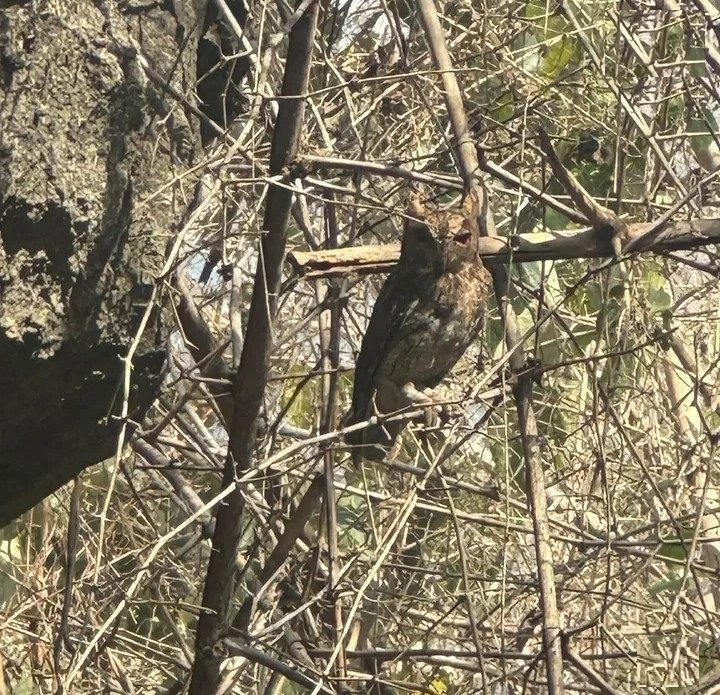
BROWN HAWK OWL: Ninox scutulata
Silent Wings. Sharp Eyes. The Mystery of the Night.
1. Introduction
The Brown Hawk-Owl (Ninox scutulata), also known as the Brown Boobook, is a species of owl belonging to the family Strigidae. It is widely distributed across South and Southeast Asia, including Indonesia.
Known for its alert expression, brown plumage, and distinctive calls, this owl is adapted to life in wooded environments. Unlike many birds that are active during the day, the Brown Hawk-Owl is primarily nocturnal, using its excellent senses to locate prey in low-light conditions.
Its hawk-like appearance and hunting behavior contribute to its common English name.
2. Physical Characteristics
The Brown Hawk-Owl is a medium-sized owl, generally measuring approximately 27–33 cm in length.
Its upperparts are predominantly brown, while the underparts are lighter and marked with pale streaks. It has prominent yellow eyes, a dark beak, and a rounded head without the prominent ear tufts seen in some other owl species.
Its relatively slender body and upright posture can give it a hawk-like appearance when perched.
Plumage patterns and coloration may vary among individuals and geographic populations.
3. Habitat and Distribution
Ninox scutulata occurs across a broad region extending from South Asia through Southeast Asia and parts of East Asia.
Its range includes countries such as India, Nepal, Bangladesh, Thailand, Malaysia, Singapore, the Philippines, and Indonesia.
The species inhabits forests, wooded landscapes, plantations, and some parks and gardens. Its dependence on wooded environments varies geographically, and forest loss can affect local populations.
During daylight hours, it commonly rests in shaded trees, where its brown plumage helps it remain concealed.
4. Behavior and Lifestyle
The Brown Hawk-Owl is primarily nocturnal, becoming active after sunset and sometimes calling around dusk and dawn.
It is often observed alone or in pairs. Its calls are an important part of its behavior and may help individuals communicate and maintain contact within their territories.
Like many owls, it relies on a combination of keen vision, hearing, and stealth to hunt in dim light.
During the day, it generally remains quiet and concealed among branches and foliage, reducing the likelihood of detection by potential predators or disturbances.
5. Diet and Hunting
The Brown Hawk-Owl is a carnivorous bird that feeds on a variety of small animals.
Its diet may include:
- Insects and other arthropods
- Frogs and lizards
- Small birds
- Mice and other small mammals
- Occasionally, other suitable small prey
It typically hunts from a perch, watching for movement before swooping down to capture its target.
By consuming insects and small vertebrates, this owl contributes to the ecological balance of the habitats in which it lives.
6. Reproduction and Nesting
Brown Hawk-Owls generally nest in natural cavities in trees, although breeding behavior and timing can vary across their extensive geographic range.
Tree cavities provide shelter for eggs and developing chicks, protecting them from some environmental conditions and potential predators.
The availability of mature trees and suitable nesting sites can therefore be important for successful reproduction.
Avoiding disturbance near active nests is an important part of responsible wildlife observation.
7. Conservation Status
According to the International Union for Conservation of Nature (IUCN), the Brown Boobook (Ninox scutulata) was assessed as Least Concern (LC) in 2021.
This classification indicates that the species does not currently meet the criteria for a globally threatened category. However, its population trend is considered decreasing.
Habitat degradation and the loss of mature forest, particularly in parts of Southeast Asia, remain concerns for the species.
Continued habitat protection and monitoring are important to ensure that populations remain healthy throughout its range.
8. Ecological Importance
As a nocturnal predator, the Brown Hawk-Owl plays an important role in food webs by feeding on insects and small vertebrates.
Its presence contributes to the biodiversity of forest ecosystems and illustrates the specialized adaptations that allow birds to occupy different ecological niches.
Learning to recognize and appreciate nocturnal birds also encourages greater awareness of wildlife that is rarely seen during ordinary daytime activities.
9. Responsible Wildlife Observation
Observing owls in their natural habitat can be a rewarding experience, particularly for birdwatchers and wildlife photographers.
To minimize disturbance:
- Observe from a respectful distance.
- Avoid shining bright lights directly into the owl's eyes.
- Do not disturb roosting birds or active nests.
- Avoid playing recorded calls repeatedly to attract the owl.
- Protect trees and natural habitats that provide food and nesting sites.
Responsible observation allows us to appreciate these remarkable birds without compromising their welfare.
10. Conclusion
The Brown Hawk-Owl (Ninox scutulata) is a fascinating nocturnal bird whose sharp senses, distinctive appearance, and hunting skills make it an important member of Asia's wildlife communities.
Although it remains classified as Least Concern globally, habitat protection is essential to its long-term survival.
By understanding its behavior and ecological role, we can develop a deeper appreciation for the hidden world of nocturnal wildlife.
Observe with patience. Explore with curiosity. Protect the wild.
Scientific References
1. BirdLife International (2021). Ninox scutulata. The IUCN Red List of Threatened Species 2021: e.T22725643A200685229.
https://doi.org/10.2305/IUCN.UK.2021-3.RLTS.T22725643A200685229.en
2. U.S. Fish & Wildlife Service. Brown Boobook (Ninox scutulata): species profile and taxonomy.
https://www.fws.gov/species/brown-boobook-ninox-scutulata
3. National Parks Board Singapore. Ninox scutulata: Brown Hawk-Owl species profile, habitat, and occurrence.
https://www.nparks.gov.sg/florafaunaweb/fauna/6/3/632
4. Avibase — Bird Checklists of the World. Brown Boobook (Ninox scutulata): taxonomy and geographic distribution.
https://avibase.bsc-eoc.org/species.jsp?avibaseid=A5AC4024C0C46CB7
5. The International Ornithologists' Union. World Bird List: global bird taxonomy and nomenclature.
https://www.worldbirdnames.org/
WILDLIFE DISCOVERY — Exploring the beauty, behavior, and biodiversity of the natural world.